Compass errors & reading accuracy
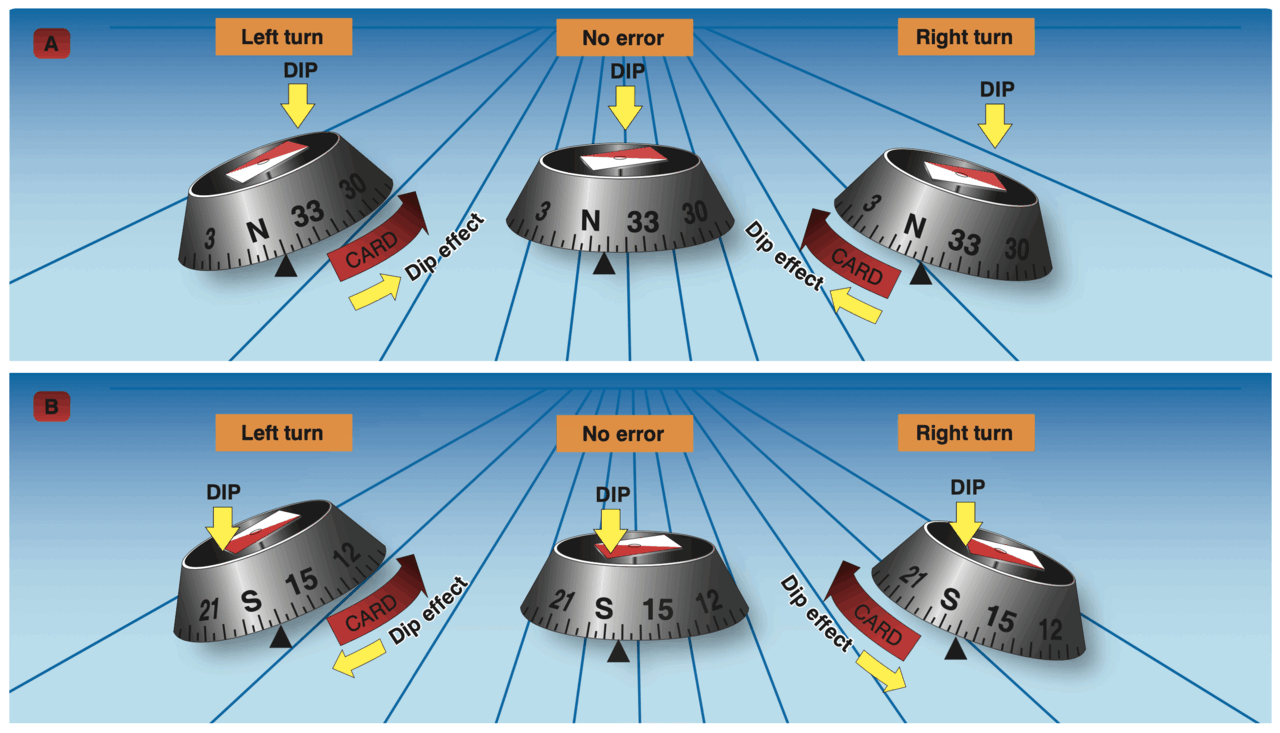
Turning error (Northern Hemisphere), UNOS = Undershoot North, Overshoot South:
| Turning onto | Compass | Turn start shows | Roll out |
|---|---|---|---|
| North | Lags | Turn in opposite direction briefly, then lags | Early (undershoot) |
| South | Leads | Correct direction immediately, then leads | Late (overshoot) |
- Both errors fade to nil by east or west (TP 1102 Ex.6).
Acceleration error on E/W headings, ANDS = Accelerate North, Decelerate South:
| Action | Reading swings toward |
|---|---|
| Accelerate | North |
| Decelerate | South |
- Wings level: error, not a real turn.
- Worst on east/west headings, nil on north/south (TP 1102 Ex.6).
Cause of both: magnetic dip (standard compass theory, not named in TP 1102/TC AIM).
- Earth's field tugs compass card down toward nearer pole, faking a turn on bank or speed change.
Compass reads true only in: straight, level, unaccelerated flight.
- Climb or descent: can be set if airspeed stays constant.
- Turbulence: take 2-3 readings and average, or read the mean of the swing (TP 1102 Ex.6).
- Errors worst near the poles: dip steepest there.
- Near a magnetic pole: horizontal component of earth's field too weak to align compass, so unusable for navigation (PHAK ch.8).
Trap: UNOS = turning (N/S roll-outs), ANDS = acceleration (E/W); swapped direction (lead vs lag, north vs south) doubles the error (TP 1102). Compass confirms steady heading only: use timed turns, never read it mid-turn; single reading in turbulence.
References
- TP 1102 (Flight Training Manual)
- PHAK ch.8 (FAA-H-8083-25)