Pitot-static instruments, blockage and pitot heat
Speed, altitude, rate-of-climb instruments run off air pressure (PHAK ch.8):
| Instrument | Pitot | Static |
|---|---|---|
| Airspeed indicator (ASI) | yes | yes |
| Altimeter | no | yes |
| Vertical speed indicator (VSI) | no | yes |
- Two pressure sources: pitot (ram air) and static.
- Each instrument reads difference between pressure sealed in its case and changing outside pressure.
- Blockage: which side is stuck, which still moves.
Instrument readings (TP 1102 Ex.2):
- ASI shows speed through the air, only indirectly related to speed over ground.
- Knot = one nautical mile per hour.
- Altimeter customarily shows height above mean sea level (MSL).
- On ground, altimeter set to current setting reads aerodrome's elevation.
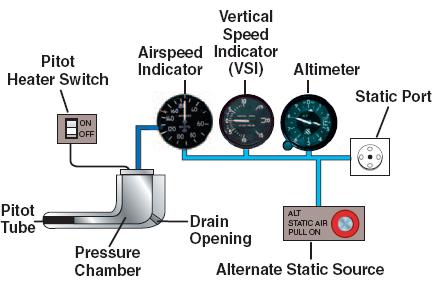
Pitot tube (PHAK ch.8 unless noted):
- Opening captures total pressure (dynamic + static).
- Small drain hole at back drains moisture in precipitation.
- Preflight: check both openings for insects, ice, forgotten pitot cover.
- Stationary on ground before takeoff: ASI reads zero. Strong wind straight into pitot can push it slightly above zero with no groundspeed.
- Visible moisture can block pitot tube. Some aircraft have pitot heat for it, used per AFM/POH.
- Icing: ensure pitot heat is on, if available (TP 1102 Ex.29).
Blockages (memorize the four):
| Blocked | Condition | ASI | Altimeter | VSI |
|---|---|---|---|---|
| Pitot | Inlet blocked, drain open | Reads zero | - | - |
| Pitot | Fully blocked (inlet + drain) | Acts like an altimeter: high in climb, low in descent | - | - |
| Static port | Pitot clear | Correct at that altitude; under-reads climbing, over-reads descending | Freezes at that altitude | Stuck at zero |
| Alternate static | Unpressurized cabin | Slightly high | Slightly high | Momentary climb |
- Pitot, drain open: ram pressure leaks out.
- Pitot, fully blocked: pressure sealed.
- Alternate static: cabin static is a bit low.
Why the ASI misreads in a climb:
| Blockage | ASI in climb | Reason |
|---|---|---|
| Pitot fully blocked | Reads high | Static falls, trapped pitot pressure can't, so gap (the "airspeed") looks bigger. |
| Static blocked | Reads low | Static trapped high while real static falls, so gap shrinks. |
Ground effect shifts static reading with no blockage (PHAK, Ground Effect):
| Phase | Static pressure at source | Effect |
|---|---|---|
| In ground effect | Usually rises | ASI and altimeter read low; aircraft can become airborne below normal indicated airspeed |
| Leaving ground effect | Drops back down | ASI jumps to higher reading; true airspeed unchanged |
Other static problems (PHAK):
- Position error: air at static entrance not absolutely still misreads ASI, altimeter, VSI, no blockage (glossary, "Position error").
- No alternate static and static blocks: break the VSI's glass face to vent pressure back in. VSI is least critical of the three, but becomes inoperative (ch.8).
Trap: pitot drain open bleeds to zero; drain also blocked traps pressure and mimics an altimeter. Blocked static moves ASI the opposite way from blocked pitot in the same climb (PHAK ch.8).
References
- TC AIM AIR 1.5
- PHAK ch.8 (FAA-H-8083-25)
- TP 1102 Ex.2 Aircraft Familiarization
- TP 1102 Ex.29 Emergency Procedures: Icing