Thunderstorm life cycle & storm motion
Three stages per cell (FAA AWH):
| Stage | Air motion | Other |
|---|---|---|
| Towering cumulus (building) | Updrafts only, can exceed 3,000 fpm (AWH 22.3) | Cloud grows. No rain reaches ground yet |
| Mature | Updrafts and downdrafts together | Heaviest rain, hail, lightning, gust front. Most dangerous |
| Dissipating | Downdraft takes over | Rain dies out. Anvil spreads downwind |
Mature transition (PHAK ch.12):
- Cell reaches mature about 15 minutes after forming.
- Starts when falling precipitation drags air down: downdraft beside still-rising updraft.
- Down-rushing air below cloud raises surface winds and drops temperature.
- Entering a storm: updrafts and downdrafts can exceed 3,000 fpm.
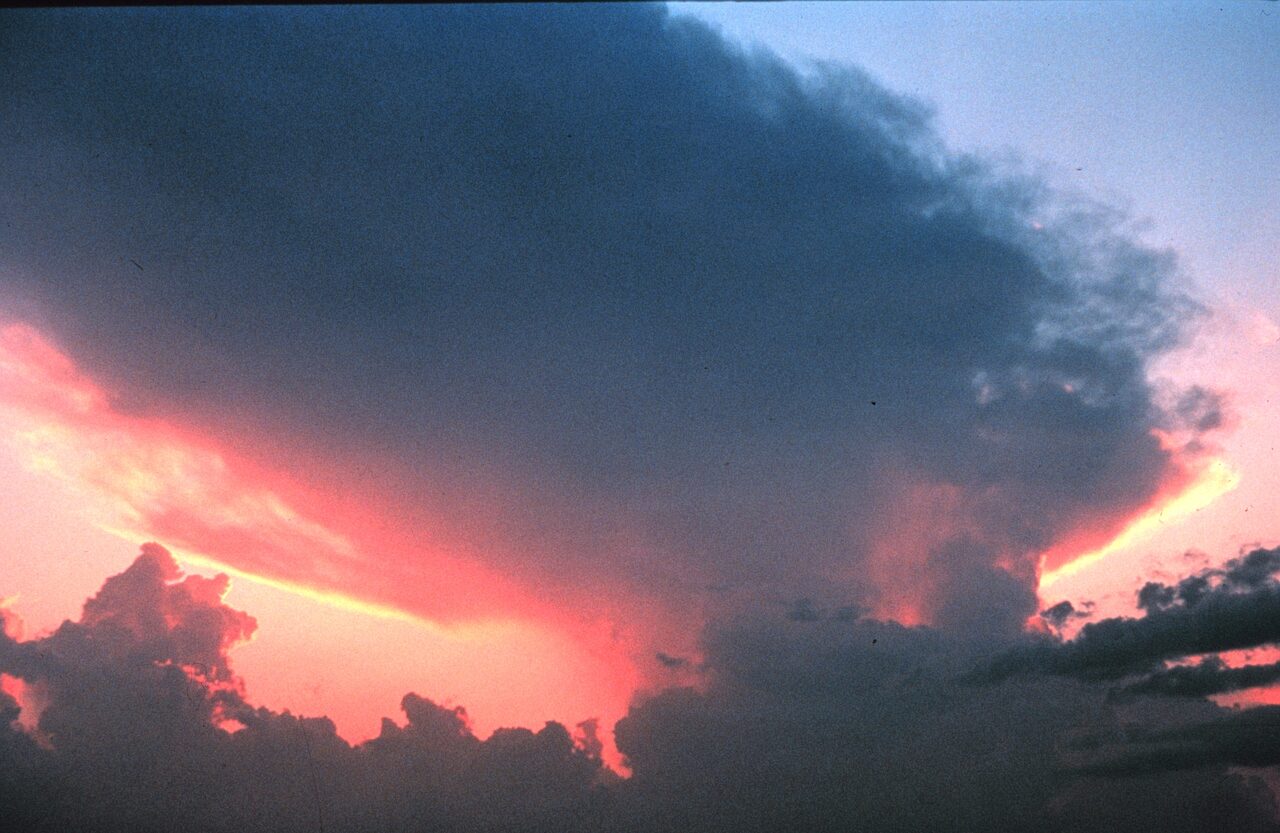
Cloud top: cumulonimbus top can overshoot into the stratosphere, far above light-aircraft climb ability (AIR 2.7.2(f)), and spread into the anvil.
Cumulonimbus vs towering cumulus: only difference is lightning and thunder (AWH A.3.4). No electrical activity: still towering cumulus.
Storm motion = advection + propagation (AWH 22.5). A storm's track is not one cell drifting with the wind.
| Component | Meaning | Guide |
|---|---|---|
| Advection | Cells moving with the average wind through the cloud's depth | FL180 (500 mb) wind approximates it (500 hPa = 18 000 ft, TC AIM MET 3.3) |
| Propagation | Old cells dying out and new cells forming, typically on the upwind flank | Storm can track away from any single cell's path |
Trap: calling towering cumulus the dangerous stage. Mature is: downdrafts and gust front appear there. Also: tracking a storm by one cell.
References
- FAA Aviation Weather Handbook (FAA-H-8083-28)
- FAA Pilot's Handbook of Aeronautical Knowledge (FAA-H-8083-25), ch.12
- TC AIM AIR 2.7.2